
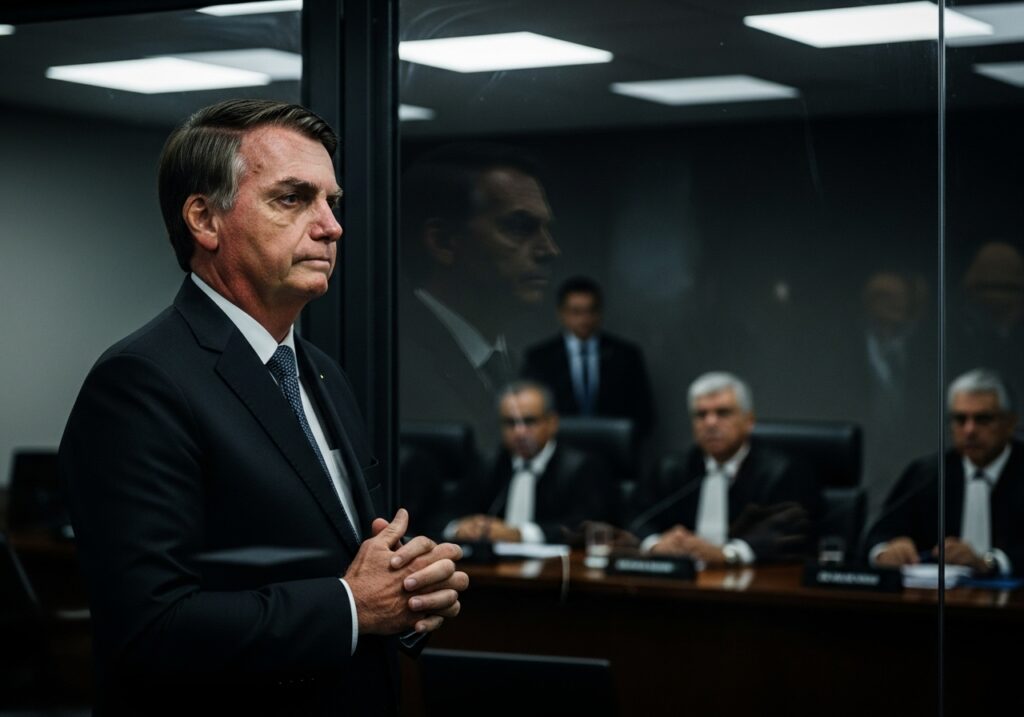
Brazil has sentenced former president Jair Bolsonaro to 27 years in prison. The charge? Crimes against democracy. But many are asking if this is true justice—or a warning sign for freedom around the world, especially here in the United States.
The charges against Bolsonaro come from Brazil’s Supreme Federal Tribunal, or STF. They say he tried to lead a coup after losing the 2022 election. That election was close and controversial. Bolsonaro, a conservative, lost to far-left candidate Luiz Inácio Lula da Silva, who is now serving his third term as president. Lula himself was once jailed for corruption before his charges were overturned.
Now Bolsonaro is accused of trying to overturn the results. The court claims he organized a group of over 30 people—what they call a “criminal organization”—to attack Brazil’s institutions. They point to the January 8, 2023 protests in Brasília, where crowds entered government buildings. Supporters say these were protests gone too far, not a planned coup. But the court disagrees.
One justice even said Bolsonaro created a “digital militia” that spread distrust in Brazil’s voting system. That sounds familiar to Americans who remember how questions about elections here have also been treated—not with debate, but with censorship and legal threats.
Bolsonaro’s trial raises serious concerns. His sentence of 27 years is extreme. He is also banned from politics for another eight years after that. His legal team says they will fight the verdict in international courts, arguing that due process was not followed and that the trial was politically motivated.
Some believe this is not real justice but a political purge. Just one of the five judges voted to acquit Bolsonaro. The rest, including Alexandre de Moraes, have a long history of cracking down on conservative voices. Moraes, who led much of the case, has used his power to silence social media accounts and block public speech by Bolsonaro and his allies. He even banned Bolsonaro from speaking publicly or using a phone while under house arrest.
This crackdown looks less like protecting democracy and more like destroying political opposition. And it has serious consequences. President Donald Trump responded in July 2025 by taking action. He issued an executive order declaring Brazil a national security threat and placed a 50% tariff on Brazilian imports. The administration also used the Global Magnitsky Act to sanction Moraes for human rights abuses, including censorship and political persecution.
U.S. Secretary of State Marco Rubio also condemned the sentencing. He called it a “witch hunt” led by a known human rights abuser. Brazil’s government fired back with threats of its own, showing how tense things have become between the two countries.
The U.S. must pay attention. What’s happening in Brazil is bigger than one man. It’s about what happens when courts are used as weapons, when free speech is called a crime, and when elections are beyond question. These are not just Brazil’s problems. They’re signs of a global trend—one where powerful elites silence dissent and call it democracy.
History has shown that once a country starts jailing former presidents, it sets a dangerous precedent. In Venezuela, Hugo Chávez and Nicolás Maduro used the courts to jail or exile political rivals. In Nicaragua, Daniel Ortega did the same. These countries are now dictatorships in all but name. We cannot ignore the pattern.
If Brazil, once seen as a rising democracy, can fall into this trap, it can happen anywhere. That’s why this matters for America. We must support free speech, due process, and the right to question those in power. If we don’t, we risk losing those rights ourselves.
This is not just about Bolsonaro. It’s about the future of liberty in the Western Hemisphere. And it’s a reminder that the fight for freedom never ends—it simply moves to new battlefields.