
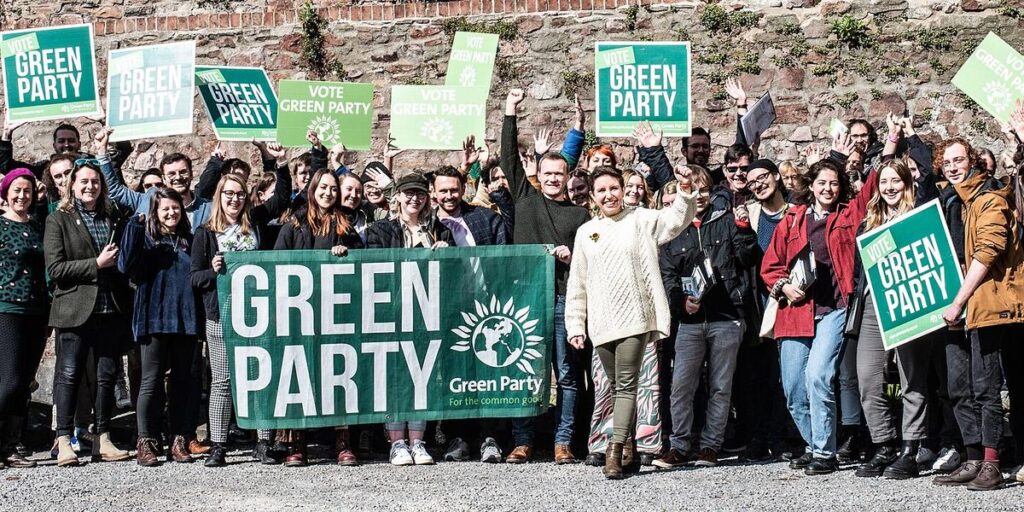
There are moments in politics when you read a policy document and have to check whether it’s satire. This is one of those moments.
The British Green Party — currently surging in polls and competing for a potentially historic by-election victory — has been caught with leaked internal documents that lay out an immigration policy so extreme it makes the American open-borders movement look cautious by comparison.
Free housing for illegal immigrants. Full access to the National Health Service. Legal aid at taxpayer expense. Universal Basic Income payments. And the foundational principle that ties it all together: a “world without borders” where migration is never, under any circumstances, a criminal offense.
That’s not a campaign slogan. That’s a policy document. Written by a political party. That people vote for.
The Policy
The 2023 internal document, obtained by the Daily Mail, states that all migrants — including those who entered the country illegally — should be “treated as citizens in waiting” and given “support” to “put down roots in their new home.”
Citizens in waiting. Not applicants. Not asylum seekers subject to review. Citizens in waiting — as if arrival on British soil is merely the first step in an automatic process that ends in full citizenship with all its benefits.
The “support” to help them “put down roots” includes free accommodation, free legal representation, access to the NHS, access to public education, financial support through Universal Basic Income “if in force,” and the same level of social services enjoyed by legal residents and citizens.
In other words: every benefit of British citizenship, available immediately, to anyone who shows up — regardless of how they arrived, whether they were invited, or whether they have any legal right to be there.
And for migrants who claim to be “LGBTOIA+” — the acronym apparently grows longer every year — the party proposes individual housing accommodation “for safeguarding purposes.” A private flat, paid for by British taxpayers, based on a self-declared identity category that requires no verification.
The “World Without Borders”
The document states that the Green Party believes in a “world without borders.” Not reduced borders. Not reformed borders. Not borders with more humane processing. No borders. The complete elimination of the concept that nations have the right to control who enters their territory.
The party further argues that migration should not be “a criminal offence under any circumstances.” Not illegal entry. Not visa overstays. Not document fraud. Not trafficking. No circumstances. Ever.
And the justification? Climate change. The Greens argue that Britain has a “collective responsibility for the climate emergency” and therefore must “support people forced to move due to the changes in their home environment.”
Climate migration as an unlimited right to resettle in Britain with full government support. That’s the argument. The entire developing world — billions of people living in regions affected by changing weather patterns — has an inherent claim on British housing, healthcare, and income support because Britain bears collective responsibility for the climate.
The policy doesn’t specify a cap. It doesn’t define limits. It doesn’t acknowledge that a small island nation with existing housing shortages, NHS waiting lists stretching months, and a strained social services system might have finite capacity to absorb unlimited migration.
Because in the Green worldview, capacity isn’t the point. Moral obligation is. And moral obligation, conveniently, has no upper limit.
The Political Contradiction
The Greens are currently competing in a by-election in Gorton and Denton, trying to upend decades of Labour dominance. Their strategy involves simultaneously courting two voter blocs with fundamentally irreconcilable worldviews: affluent young progressives and Muslim communities.
The party released campaign advertisements in Urdu and Bangla. They campaigned in all 14 of the constituency’s Muslim mosques. They’re pursuing the Muslim vote aggressively — while simultaneously advocating for LGBTOIA+ housing privileges, transgender rights, and the full spectrum of progressive social policies that are deeply unpopular in socially conservative Muslim communities.
This coalition holds together only as long as nobody asks uncomfortable questions. The moment a Muslim voter reads the LGBTOIA+ housing policy, or a progressive voter encounters the party’s mosque-based outreach strategy, the contradictions become visible. The Greens are selling two incompatible visions to two incompatible audiences and hoping neither audience reads the other’s brochure.
The Reform Response
Reform UK’s Shadow Home Secretary Zia Yusuf delivered the response the policy deserves: “Under the Greens’ open-borders plans, not only is every hoodlum and criminal welcome to our shores but entitled to free housing, healthcare and anything else they might fancy.”
Reform is currently neck and neck with the Greens in the Gorton and Denton race — a contest that will tell Britain whether its political future lies with the party offering unlimited free everything to anyone who crosses the Channel, or the party that thinks borders should exist and laws should be enforced.
The Pattern
The Green Party’s immigration policy isn’t new. It’s the logical endpoint of a political philosophy that has been building across the Western left for decades. Start with asylum. Expand to humanitarian migration. Redefine economic migration as a human right. Eliminate the distinction between legal and illegal entry. And eventually arrive where the Greens are now: a world without borders, where every migrant is a citizen in waiting, and every taxpayer is obligated to fund their arrival.
Britain is watching this in real time. A political party that wants to govern is openly proposing that the nation has no right to control its borders, no authority to distinguish between legal and illegal residents, and an unlimited financial obligation to house, feed, heal, and pay anyone who arrives.
The Green Party spokesman said they’re “proud of this policy” and that it’s “popular.” Thursday’s by-election will test whether that’s true — or whether British voters, like American voters before them, have decided that a country without borders isn’t a country at all.