
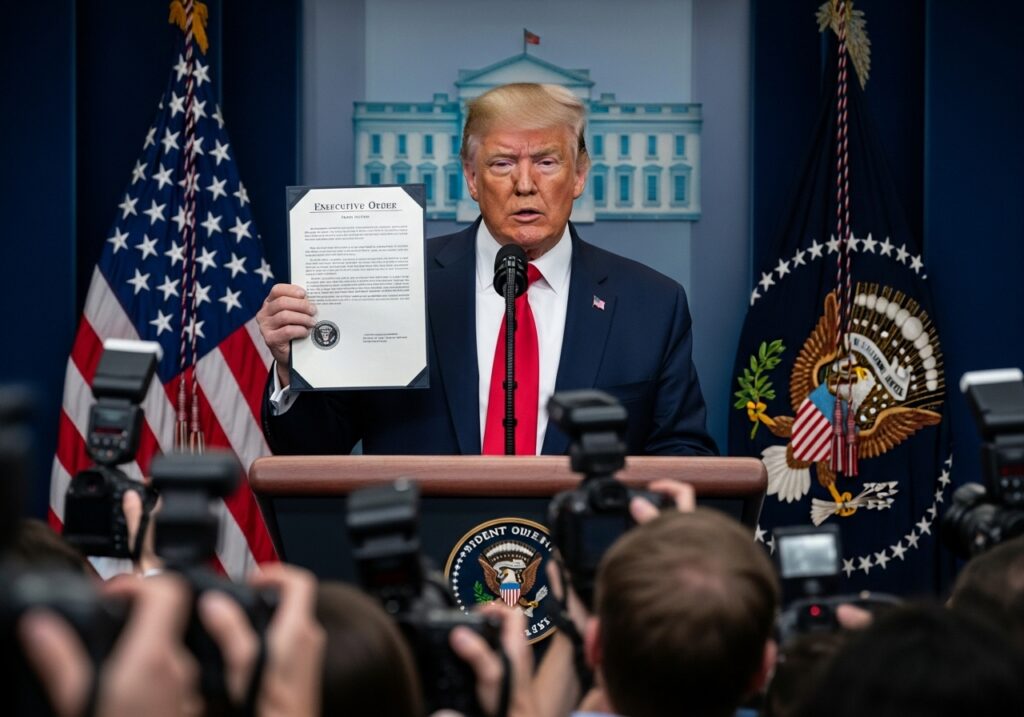
The future of America’s economic independence is now in the hands of the Supreme Court. At the heart of the debate is whether President Trump has the authority to use emergency powers to protect American industries and workers through tariffs. The case, Learning Resources, Inc. v. Trump, is more than just a legal argument—it’s a test of whether the United States can defend itself economically in a world where foreign governments manipulate trade to their advantage.
Back in 2019, President Trump invoked the International Emergency Economic Powers Act, or IEEPA, to impose a 10% tariff on a broad range of foreign imports. His reasoning was simple: America’s massive trade deficit, largely driven by unfair practices from countries like China, was a national emergency. This wasn’t about politics—it was about protecting American jobs, rebuilding domestic manufacturing, and putting our country first. But now, even some of the conservative justices appointed by President Trump are questioning whether IEEPA gives the president that kind of power.
Justices Neil Gorsuch and Amy Coney Barrett raised concerns about whether the law was being stretched too far. They’re worried about the balance of power between the president and Congress. And that’s a fair concern—our Constitution puts checks on every branch of government for a reason. But the bigger question is this: if the president can’t act swiftly to protect American industries during an economic emergency, who will?
IEEPA was passed in 1977 to give the president tools to deal with foreign threats. While it doesn’t specifically mention tariffs, it does give the president broad powers to block or limit economic activity involving foreign nations. For decades, presidents from both parties have used it to impose sanctions and embargoes. President Trump’s use of IEEPA to impose tariffs follows the same logic—it’s a defensive move in an economic war that’s already been declared by our rivals abroad.
Critics argue that existing trade laws, like Section 232 and Section 301, already give the president the authority to impose tariffs in specific situations. That’s true—but those laws are narrow and slow-moving. They weren’t built for the scale or urgency of the trade crisis we face today. President Trump’s approach is bold and aggressive, because that’s what the moment calls for. China, in particular, has flooded our markets with cheap goods, stolen intellectual property, and used state subsidies to crush American competition. If that’s not an emergency, what is?
This case is about more than just legal language. It’s about whether the United States can defend its own economy in a hostile global environment. Our national security isn’t just about tanks and missiles—it’s about economic strength. A country that can’t produce its own steel, semiconductors, or pharmaceuticals is vulnerable. President Trump understands that, which is why he’s used every tool available to revive American industry.
Some justices worry that allowing the president to use IEEPA for tariffs might give too much power to future executives. But that’s not a reason to strip away the authority of a president who’s actually fighting for American workers. The real threat isn’t presidential overreach—it’s congressional inaction. For decades, Congress has failed to stand up to globalist trade deals and foreign economic aggression. When Washington lawmakers won’t act, the president must.
The Supreme Court is expected to rule by late June. If they side against President Trump, it could weaken our ability to respond to economic threats. But if they uphold his use of IEEPA, it will be a major win for economic nationalism and for the principle that America has the right to defend its own interests.
This isn’t just a legal battle—it’s a fight for America’s future. We need strong leadership that puts our country first, not endless debate over legal technicalities while foreign powers eat away at our industries. President Trump has shown he’s willing to take that stand. Now the Supreme Court must decide whether to back him—or leave America defenseless in the global economic arena.