
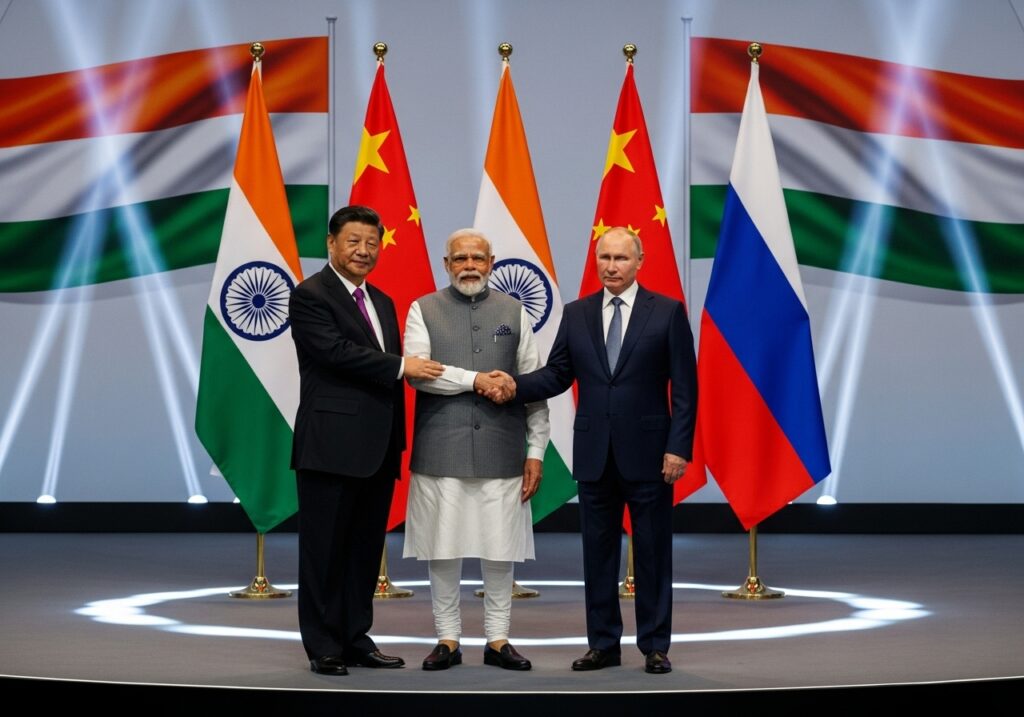
President Donald Trump recently warned that the United States has “lost” both India and Russia to China. His words came after China’s leader, Xi Jinping, hosted Indian Prime Minister Narendra Modi and Russian President Vladimir Putin at a high-profile summit. The meeting showed a growing bond between three of the world’s biggest powers—and a possible shift in the global balance of power that could hurt America’s long-term security.
For decades, the United States has built partnerships around the world to protect its interests and keep peace. India and Russia were once key parts of that strategy. But things are starting to change. China is working hard to pull these countries closer, and it’s making real progress. If the U.S. doesn’t act fast, we may find ourselves shut out of key regions and surrounded by countries that no longer look to America for leadership.
Let’s take a closer look at what’s going on.
India has long been seen as a natural ally to the United States. It’s a democracy, it shares concerns about China’s growing power, and it has a large, young population that powers a fast-growing economy. In recent years, the U.S. and India have signed defense deals, held joint military exercises, and talked about working together to keep the Indo-Pacific region free and open.
But now, India is hedging its bets. Prime Minister Modi’s decision to attend a summit hosted by China—and to meet with both Xi and Putin—signals that India may be looking for new partners. While India still sees China as a rival, it may also see value in playing both sides. That’s dangerous for the U.S. If India drifts too far toward China, America could lose a key partner in Asia at a time when China is expanding its navy, building military bases, and threatening Taiwan.
Russia is a different story. Once a Cold War enemy, Russia grew closer to the West after the fall of the Soviet Union. But that relationship has been falling apart for years. Under Vladimir Putin, Russia has invaded Ukraine, formed military ties with Iran, and sold weapons to America’s enemies. Now, with China offering trade, technology, and diplomatic support, Moscow is moving deeper into Beijing’s orbit.
This is a serious shift. The more Russia depends on China, the more power China gains in Eurasia. Together, they can challenge U.S. leadership in places like the Middle East, Central Asia, and even Africa. They can work around Western sanctions, spread anti-U.S. propaganda, and build their own financial networks to avoid the dollar. All of this weakens America’s global influence.
President Trump is right to raise the alarm. The summit between these three leaders is more than just a photo-op. It’s a sign that America’s rivals are working together to build a new world order—one where U.S. power counts for less. If current trends continue, the United States risks being isolated while countries like China dictate the rules of trade, security, and even free speech.
So what should we do? First, we need to rebuild trust with our partners. That means strengthening ties with India, not taking them for granted. It means speaking openly with Modi about the risks of getting too close to China. Second, we need to keep pressure on Russia, while also being smart about how China is using Russia to increase its own power. And third, we must invest in our own military, economy, and energy independence so we are not vulnerable to foreign pressure.
The world is changing fast. China is making bold moves, and it’s winning over countries we once counted as friends. America must respond with strength and clarity. Our freedom, our security, and our future depend on it.