
There are two ways to negotiate with a regime like Iran.
You can do it the Obama-Biden way: fly pallets of cash to Tehran in the middle of the night, give them everything they want, call it a “framework,” and pretend they’ll honor an agreement they signed with their fingers crossed.
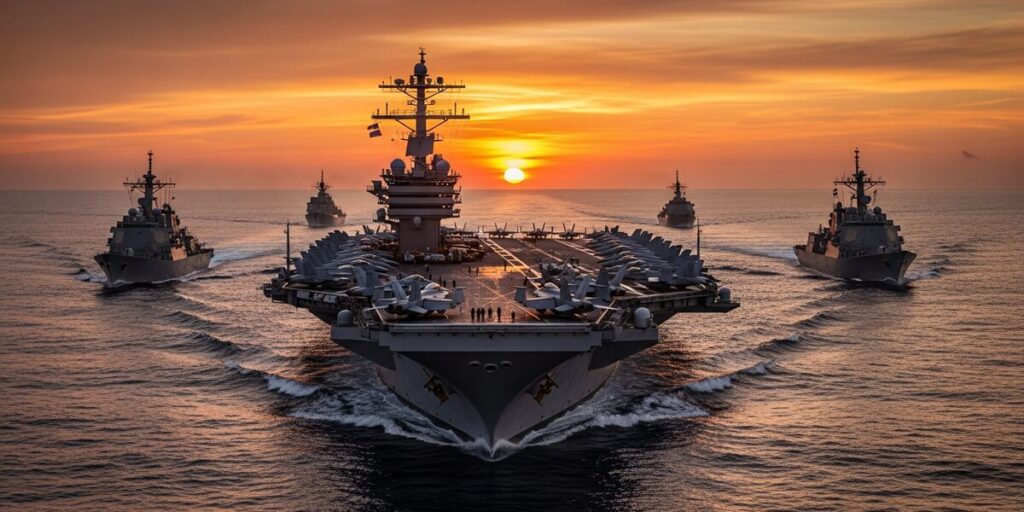
Or you can do it the Trump way: park an aircraft carrier strike group off their coast, remind them you’ve already bombed their nuclear facilities once, and ask very politely if they’d like to talk.
Guess which approach actually works?
The Flotilla
President Trump sat down with Larry Kudlow on Tuesday and laid out the situation with characteristic bluntness.
“We have a massive flotilla right now going over to Iran,” Trump said. “I think they want to make a deal. I think they’d be foolish if they didn’t.”
Then came the reminder: “We took out their nuclear power last time, and we’ll have to see if we take out more this time.”
That’s not rhetoric. That’s a direct reference to Operation Midnight Hammer — the U.S. strikes on Iran’s nuclear sites roughly six months ago that capped the twelve-day Israel-Iran war. Trump didn’t just threaten military action. He reminded Tehran that he’s already done it once and has no hesitation about doing it again.
The USS Abraham Lincoln and its strike group are already en route. According to Axios, discussions are underway about deploying a second carrier strike group if negotiations collapse.
Two carrier strike groups off the coast of Iran. That’s not a diplomatic gesture. That’s the mailed fist inside the velvet glove.
The Terms
Trump was clear about what any deal must include: “No nuclear weapons, no missiles.”
Not reduced enrichment. Not limits on centrifuges. Not promises to behave. No nuclear weapons. No missiles. Period.
This is where Trump’s approach differs fundamentally from Obama’s disastrous JCPOA. That deal — which Trump correctly called “one of the dumbest deals I’ve ever seen” — essentially paid Iran to temporarily slow its nuclear program while allowing it to continue missile development and fund terrorist proxies across the region.
Trump isn’t interested in temporary measures or diplomatic theater. He wants Iran’s nuclear program dismantled and its missile capabilities addressed. Anything less isn’t worth the paper it’s printed on.
Iran’s Red Lines
Tehran has responded by insisting that negotiations be limited to enrichment levels — not the existence of enrichment itself — and has categorically rejected any discussion of missiles or regional proxies.
In other words, Iran wants to negotiate about how fast they can build a bomb, not whether they’re allowed to build one at all.
This is the same game they’ve played for decades. String along Western diplomats with endless talks. Make minor concessions that can be reversed overnight. Pocket whatever benefits they can extract. And keep the centrifuges spinning.
Trump isn’t playing. His position is simple: comprehensive deal or military action. Pick one.
The Netanyahu Meeting
Israeli Prime Minister Benjamin Netanyahu arrives in Washington Wednesday for talks with Trump. Iran will be “first and foremost” on the agenda.
Netanyahu has made clear he’ll present “essential principles” he considers vital not just for Israel but for global security. U.S. Ambassador to Israel Mike Huckabee described “extraordinary alignment” between the two nations on the Iran issue.
This is the nightmare scenario for Tehran: the United States and Israel completely unified, military assets deploying, and a president who has already demonstrated he’s willing to pull the trigger.
The mullahs built their entire strategy around exploiting divisions between America and Israel, between the White House and Congress, between the U.S. and its European allies. Trump has closed those gaps. There’s no daylight to exploit.
The Military Posture
While diplomats talk, the military prepares.
Satellite imagery shows Patriot air defense systems at Al-Udeid Air Base in Qatar — the largest U.S. installation in the Middle East — mounted on mobile platforms for rapid repositioning. That’s not routine maintenance. That’s preparation for potential Iranian retaliation against American forces.
The Wall Street Journal reports the administration is considering expanded seizures of tankers carrying Iranian oil — a move that would squeeze Tehran’s revenue while risking Iranian retaliation in the Strait of Hormuz.
And Iran’s Army chief warned Tuesday that any “miscalculation” would be met with an “unprecedented” response.
This is what real diplomacy looks like. Not John Kerry flying to Geneva for another round of handshakes. Not carefully worded joint statements. Ships. Planes. Missiles. The understanding on both sides that this could get very real, very fast.
Why This Works
Critics will say Trump is being reckless. That he’s risking war. That diplomacy requires patience and compromise.
They said the same thing before Operation Midnight Hammer. They said the same thing when Trump pulled out of the JCPOA. They said the same thing when he killed Qasem Soleimani.
And every time, they were wrong.
Iran responds to strength. The regime isn’t suicidal — it wants to survive. When the cost of defiance becomes higher than the cost of compliance, Iran makes concessions. When they think America is weak or distracted, they push forward.
Obama gave them weakness. They got a nuclear program on the brink of weapons capability and a region destabilized by Iranian proxies.
Trump gave them strength. They got their nuclear facilities bombed and their top general killed.
Now Trump is giving them a choice: comprehensive deal or more of the same.
The mullahs aren’t stupid. They know what’s coming if they say no. The only question is whether their pride will override their survival instinct.
The Stakes
Make no mistake: a nuclear-armed Iran changes everything.
It triggers an arms race across the Middle East. Saudi Arabia, Turkey, Egypt — all would pursue their own nuclear programs. The region’s already combustible politics would be conducted under a nuclear shadow.
It emboldens Iranian proxies. Hezbollah, Hamas, the Houthis — all would operate with the backing of a nuclear state. Israel’s margin for error in any conflict would shrink to nothing.
It threatens American interests directly. Iran has already targeted U.S. forces and installations. With nuclear weapons, those threats become existential rather than manageable.
Trump understands these stakes. That’s why he’s not interested in half-measures or face-saving compromises. The only acceptable outcome is an Iran that cannot build nuclear weapons and cannot threaten its neighbors with ballistic missiles.
Everything else is just kicking the can down the road.
The Bottom Line
A massive flotilla is heading toward Iran. A second carrier strike group may follow. Netanyahu is coming to Washington to coordinate with Trump. Military assets are repositioning across the region.
And Trump has made the choice crystal clear: make a deal that actually addresses the problem, or face consequences Iran has already experienced once and doesn’t want to experience again.
“I’d rather make a deal,” Trump said. But he was clear about the alternative: “We have to do something very tough like last time.”
The mullahs have a decision to make. They can negotiate seriously — no nuclear weapons, no missiles, verifiable and permanent — or they can watch American aircraft carriers off their coast and wonder which facility gets hit first.
That’s not warmongering. That’s leverage.
And it’s the only language Tehran understands.