
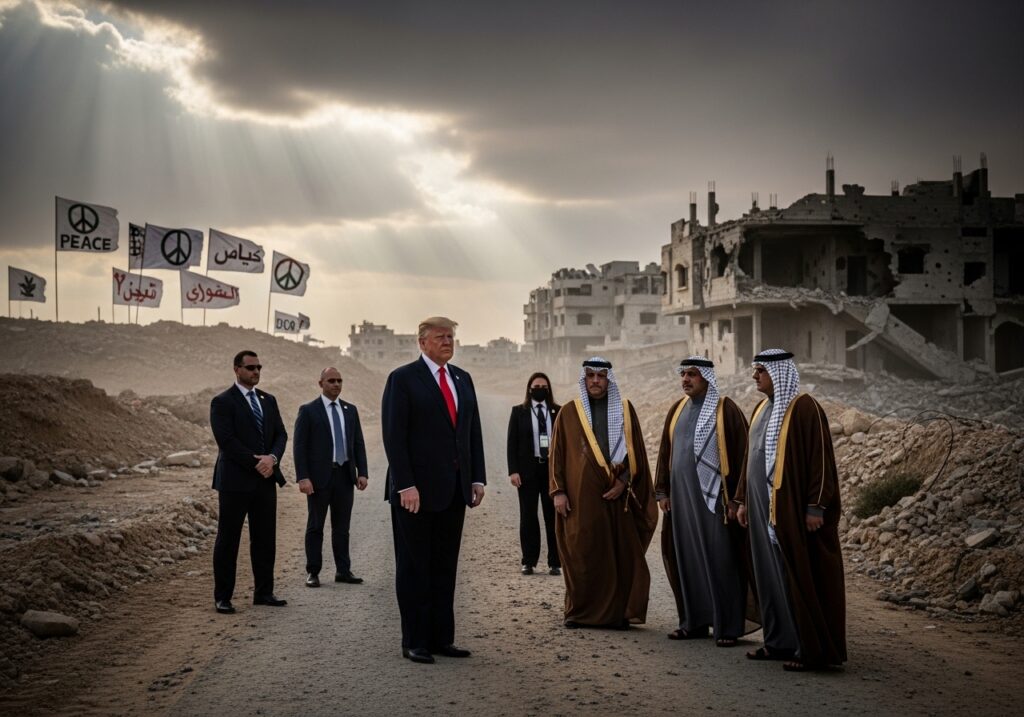
President Donald Trump has confirmed plans to visit the Gaza Strip following the breakthrough peace agreement between Israel and Hamas. The announcement marks a bold step in Trump’s foreign policy, and it sends a clear message: the United States is back in command on the world stage, and respect for American leadership is the cornerstone of Middle East stability.
Trump made these remarks during an interview with *Time* magazine, where he emphasized that peace in the region hinges not just on diplomatic documents, but on the authority and respect commanded by the President of the United States. “If they don’t respect the president,” he said, “it could break apart.” This is not just political posturing—it’s a hard truth in international relations. When America leads with strength, allies follow and enemies rethink their plans.
The cease-fire between Israel and Hamas, which began on October 10, brought an end to a bloody chapter that had stretched for months. The deal included the release of the last 20 Israeli hostages and the return of more than two dozen remains. While fragile, the agreement represents a major diplomatic victory for the Trump administration. It wasn’t achieved by appeasement or backroom deals—it was forged through blunt talk, pressure on all sides, and a clear understanding of what is at stake.
According to Trump, a key moment came when he confronted Israeli Prime Minister Benjamin Netanyahu directly. “Bibi, you can’t fight the world,” Trump recalled telling him. That kind of frank, personal diplomacy—backed by America’s unmatched military and economic power—is what turned the tide. Israel, long isolated diplomatically, now stands at the center of a growing circle of peace through strength.
Trump also made clear that Saudi Arabia is now positioned to join the Abraham Accords, the landmark agreements that normalize relations between Israel and Arab states. “They had a Gaza problem and they had an Iran problem. Now they don’t,” Trump said. This is a significant development. If Saudi Arabia, the spiritual and political center of the Sunni Muslim world, formalizes ties with Israel, the balance of power in the Middle East will shift dramatically in favor of U.S. allies.
But Trump is not giving Israel a blank check. He sharply criticized Israel’s September bombing of Hamas leaders in Qatar, calling it a “tactical mistake.” More importantly, he drew a red line on the West Bank. “It won’t happen,” Trump said when asked about Israeli annexation plans, “because I gave my word to the Arab countries.” That statement underscores a strategic principle: even close allies must act in ways that support broader regional stability if they want continued U.S. backing.
This is a new kind of diplomacy—one where America’s interests come first, but where peace is achieved not by endless negotiation, but by making clear what the United States will and will not support. Trump’s warning to Hamas was just as firm. If they backtrack on the deal, “nobody would mind if we went in and took them to task,” he said. That’s deterrence in action. Peace is not kept by promises alone, but by the certainty of consequences.
The Gaza visit, if it happens, will be historic. No sitting American president has ever stepped foot in the war-torn enclave. By going there, Trump would signal a new era—not only of American presence, but of American authority. And the symbolism would be powerful: a president who stands with allies, holds enemies accountable, and puts American leadership at the center of global peace.
This deal, like the Abraham Accords before it, proves that peace in the Middle East is possible—but only when the United States leads with strength and clarity. For too long, American policy was guided by confusion, weakness, and the illusion that diplomacy alone could fix deep-rooted conflict. Trump’s approach is different. It’s working. And the world is paying attention.