
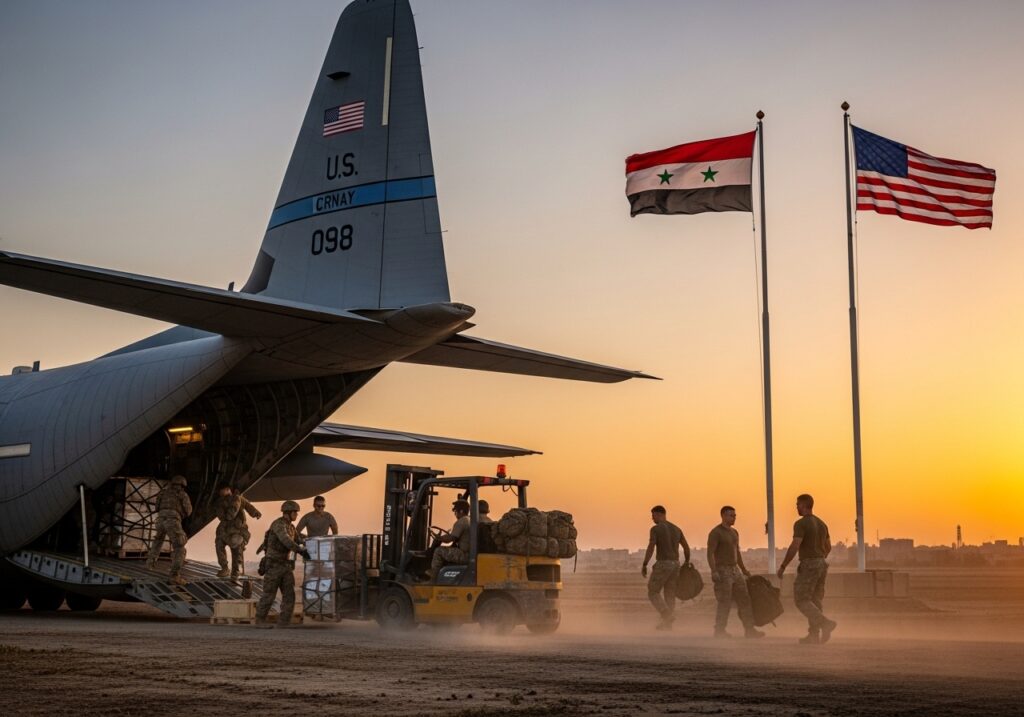
In a bold and strategic move, President Donald Trump is reshaping the Middle East once again—this time by preparing to deploy U.S. military forces to an airbase in Damascus, Syria. This development, confirmed by multiple sources, marks a serious shift in America’s role in the region and could have important consequences for our national security, our alliance with Israel, and the long-term stability of the Middle East.
This isn’t just about putting boots on the ground. It’s about securing peace through strength. After the fall of Syrian dictator Bashar al-Assad in late 2024, Syria has entered a new chapter. The collapse of Assad’s brutal, Iran-backed regime creates an opening for the United States to step in and support a more stable, pro-Western Syria—one that no longer serves as a puppet for Tehran. That’s exactly what President Trump is doing.
Syria’s new leader, President Ahmad al-Sharaa, is scheduled to meet with Trump at the White House. This is a historic event: the first ever visit of a Syrian head of state to Washington. It signals a turning point not just for Syria, but for the entire region. This is the kind of diplomacy that was unthinkable under previous administrations. Trump is not just talking about peace—he’s doing the hard work to make it happen.
The plan to use a Damascus airbase as a monitoring post for a potential Israel-Syria security pact is a smart and necessary move. After decades of hostilities, the idea that Syria and Israel could come to a mutual security understanding represents a once-in-a-generation opportunity. But such a pact will only hold if there is a strong and credible guarantor—and that guarantor must be the United States.
Let’s be clear: this is not about nation-building or endless war. Trump has made it clear he opposes those failed policies. This is about deterrence, intelligence gathering, and regional stability. U.S. forces will not be occupying Syria. According to reports, the base will remain under Syrian control. Our troops will be there in a support role, helping ensure that any agreement between Syria and Israel is enforced and that Iran doesn’t try to sneak back into the picture.
This deployment sends a powerful message to Iran and its terrorist proxies like Hezbollah: the days of unchecked aggression are over. Under the weak leadership of Barack Obama and Joe Biden, Iran was allowed to expand its influence across the region—from Iraq to Syria to Lebanon. That era is ending. Trump understands that American security begins with strength abroad. When we draw red lines, we must be ready to back them up.
The decision to keep the location of the base classified for now is also the right call. Operational security is critical. We’ve seen in the past what happens when sensitive military plans are leaked or politicized. This White House is making national security decisions based on strategy, not ideology.
Critics will say this is risky. But the real risk is doing nothing. A power vacuum in Syria would invite chaos, terrorism, and more Iranian meddling. That would threaten not just Israel, but also our allies in the Gulf and eventually our homeland. Remember, ISIS once thrived in the Syrian desert. We cannot afford to repeat the mistakes of the past.
President Trump’s leadership in the Middle East continues to defy expectations. While the media obsesses over domestic squabbles, Trump is building a new order in the region—one where peace is achieved not through weakness, but through resolve. The deployment to Damascus is not just a military decision; it is a geopolitical chess move that puts American interests first.
For decades, U.S. policymakers have talked about peace in the Middle East. Trump is actually delivering it. And in doing so, he is making America stronger and safer.